🧠💛
Empathy Builder Lab
A Brave Feelings Lab Journey — learn to see what others feel
Enter Your Access Code
Hint: Use code
Welcome to Empathy Builder Lab
A Brave Feelings Lab journey in understanding people.

Benne Hart Says:
Hi, I'm Benne. I'm really glad you're here today.

This is a special place where you'll learn one of the most important skills a person can ever have. Enter when you're ready.
📋 What You'll Learn
How to notice people who need to be seen. How to understand what others feel. How to respond with real compassion. Five powerful Empathy Steps — all yours to keep.
Have you ever really been understood?
Think of a moment when someone truly got how you felt.
Benne Hart Says:
Think about a time when someone truly understood how you were feeling — he didn't try to fix it or tell you to cheer up — he just got it. How did that feel?
🛡️
It felt safe — like I wasn't alone
😮
It felt surprising — I didn't expect it
💭
I wish it happened more often
🌱
It hasn't happened for me yet
Empathy isn't magic. It's a skill.
And every skill can be learned and practiced.
Benne Hart Says:
Empathy is the ability to understand and care about what another person is feeling — even when his feelings are different from yours.

It has two parts that work together:
🌱 The Good News
Both parts can be practiced and strengthened. Research confirms empathy is not fixed — it grows with practice. That's what this lab is for.
Your Five Empathy Steps
One step at a time — we'll build him all together.
Benne Hart Says:
Here's the framework we'll build together. Each step is a skill. Each skill builds on the last. By the end, you'll use all five together.
👁️
Step 1
NOTICE
❤️
Step 3
FEEL
🚪
Step 4
THINK
🤲
Step 5
ACT
Which step do you think will be easiest for you?
👁️
NOTICE — I already pay attention to people
❤️
FEEL — I connect with emotions easily
🤲
ACT — I like doing things to help
That's a great starting point. We'll build every step — including the ones that feel harder. Ready for Phase 1?
👁️
Phase 1
The Noticing Skill
Steps 1 & 2: NOTICE + READ
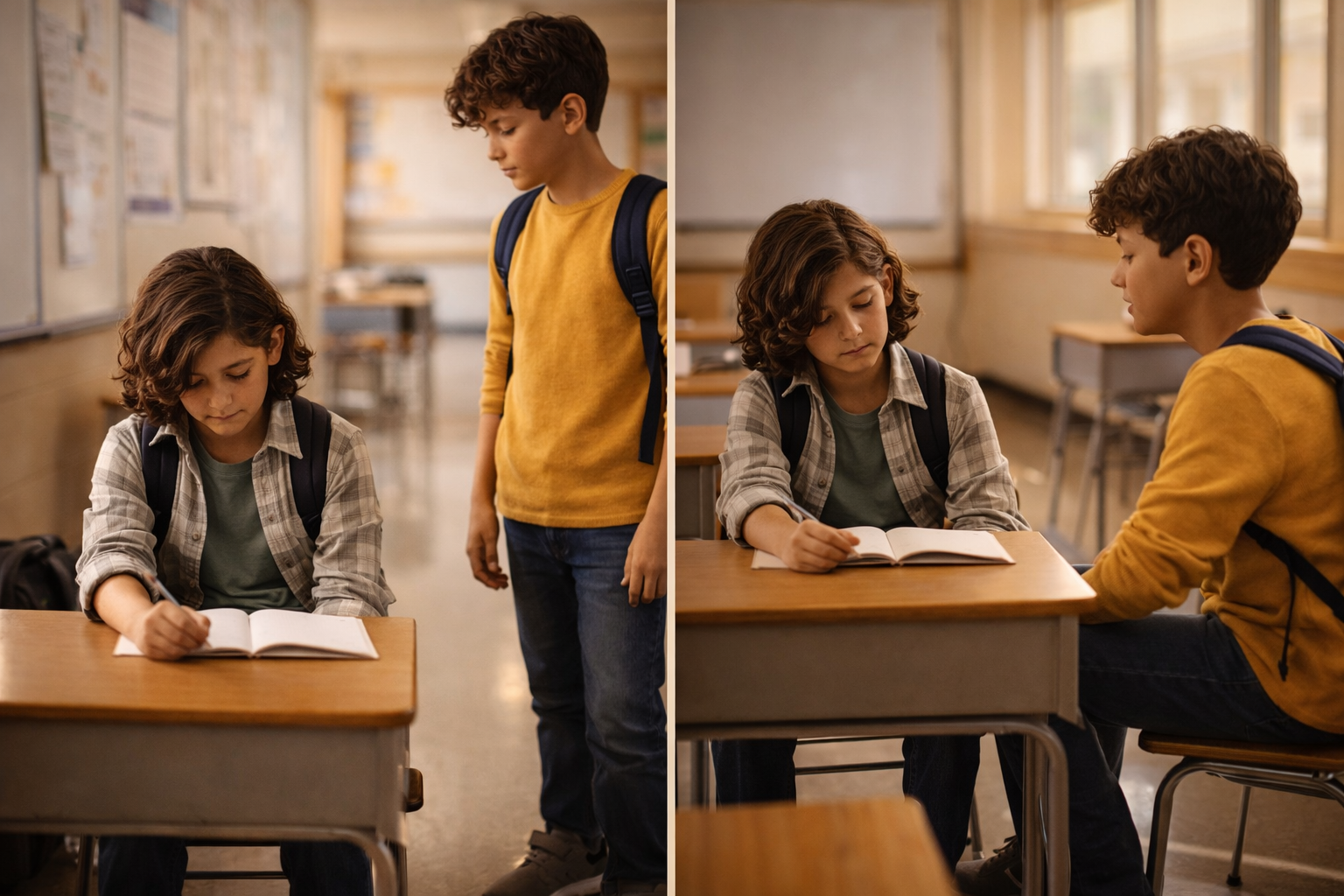
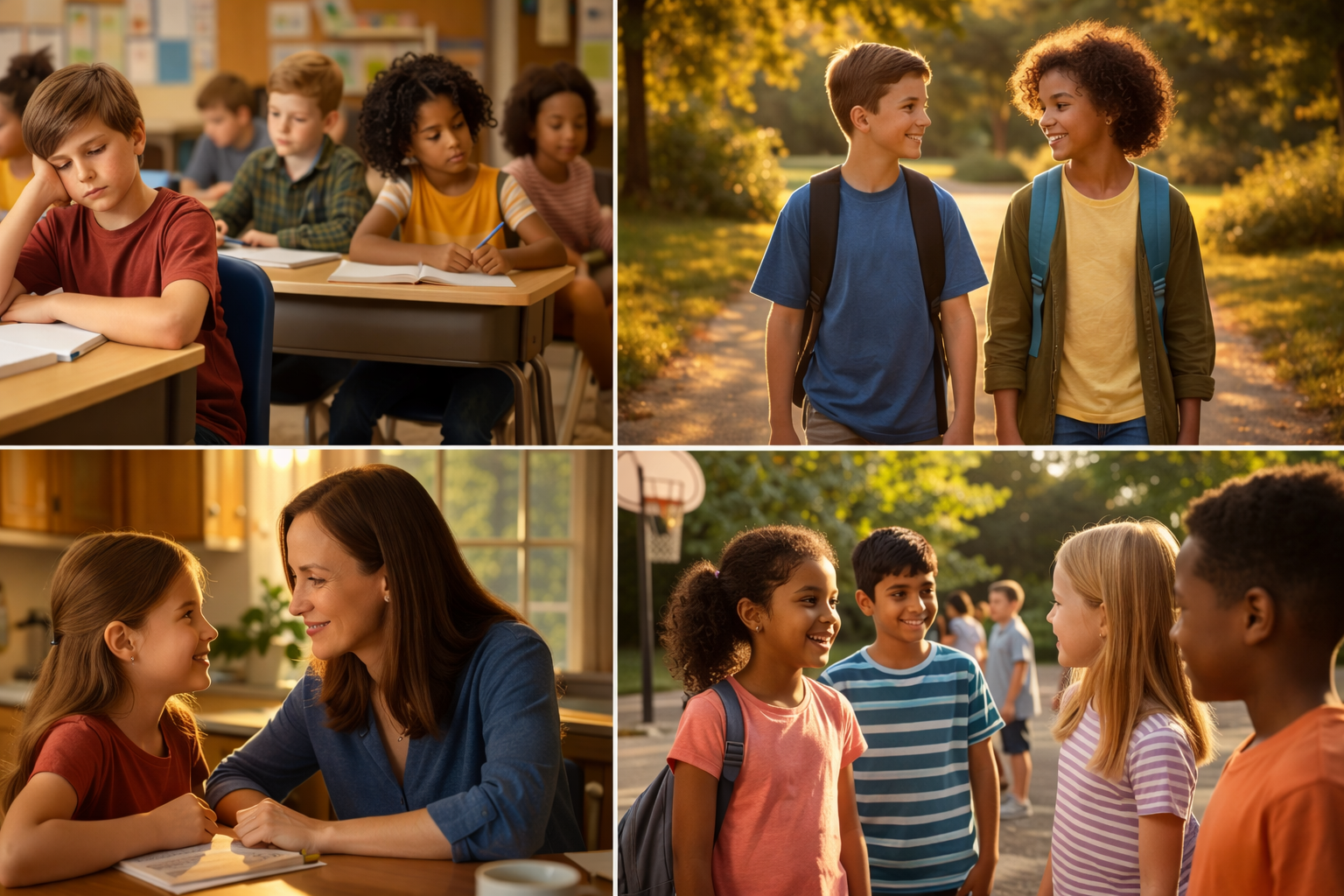
Scenario: The Classroom
Everyone was busy. No one noticed.
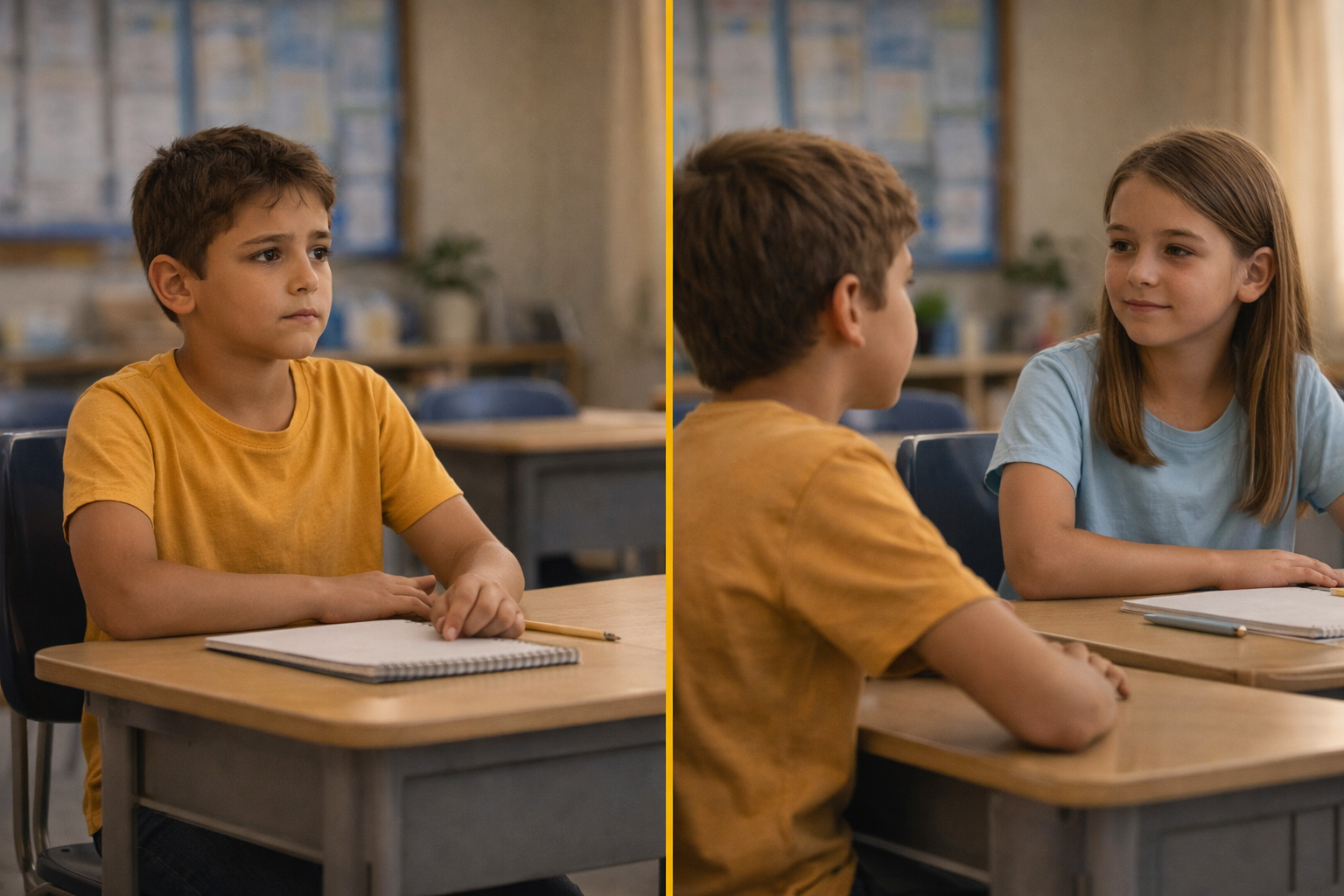
A classroom full of children working. In the corner, one child sits with slumped posture, pencil still, looking downward. No one has looked up from his own work.
Benne Hart Says:
Empathy always starts with attention. You can't empathize with someone you haven't noticed. The question is: are you truly looking?
What do you notice about the child in the corner?
😶 Pencil is still
🪑 Slumped posture
👀 Eyes looking down
🔕 Very still
😶 Not joining in
You found the clues. That took something important — you had to slow down and actually look. That's Step 1: NOTICE. 👁️
The body tells the story.
When we notice, we read more than just the face.
Benne Hart Says:
When we notice, we don't just look at someone's face. We read the whole picture. Every part of the body is trying to tell you something. When you notice, you're listening with your eyes.
👁️ Eyes
Are he bright and open, or heavy and far away? Eyes looking down can mean embarrassment, sadness, or being lost in thought.
🧍 Posture
Open and upright means engaged. Curved inward, hunched shoulders — that's someone carrying something heavy.
🤲 Hands
Still hands vs. restless fidgeting. A tight grip. Hands covering the face. Every gesture is a signal.
Match each body clue to what it might mean:
😮‍💨 Shoulders hunched → Burdened
🤐 Arms crossed → Guarded
👇 Eyes down → Embarrassed
🦶 Foot tapping → Anxious
You're already reading people with more skill than most people realize he have. That's Step 2: READ. 🔍
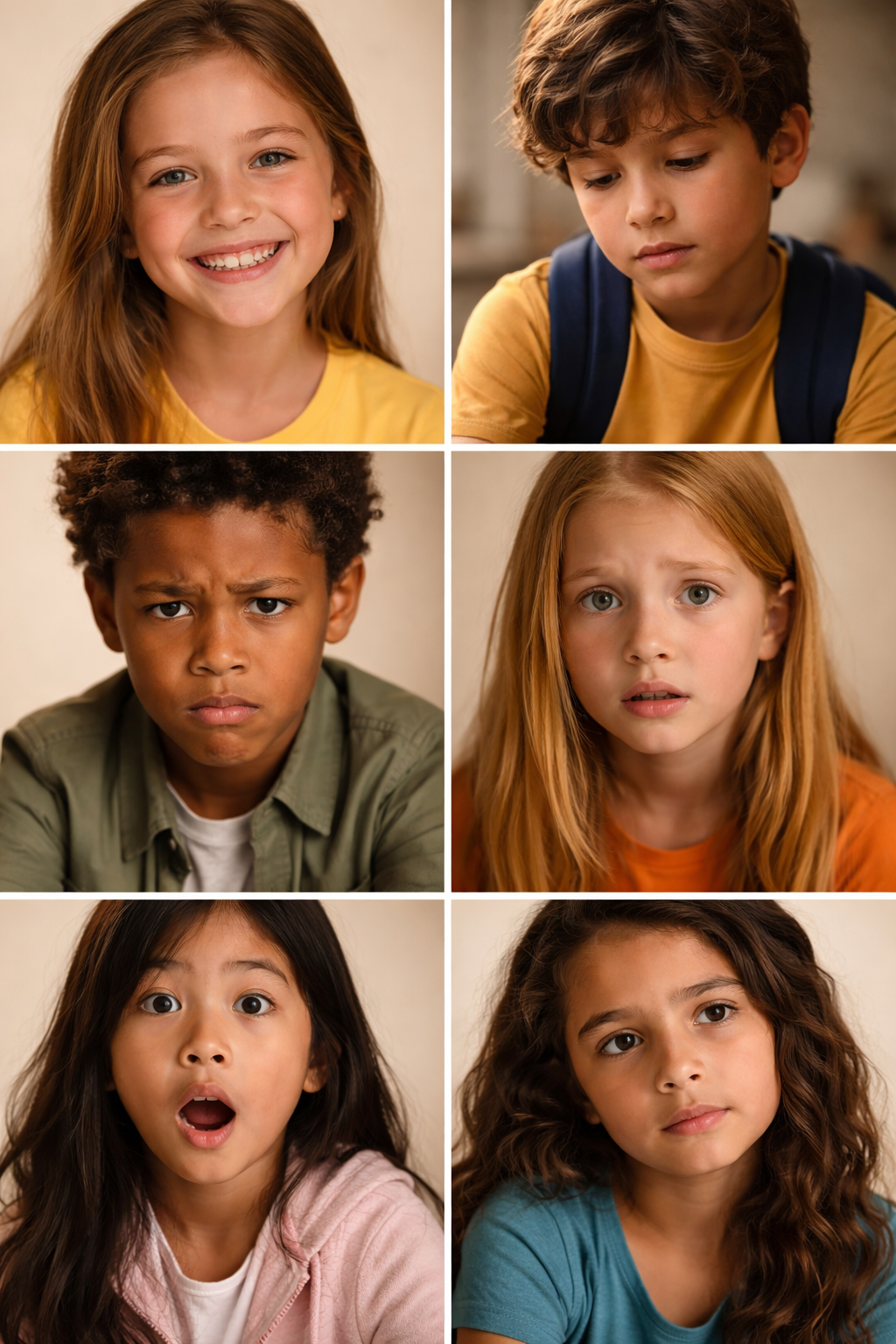
What do you see?
Read each face. You're not guessing — you're reading.
Benne Hart Says:
Look at each face and choose the emotion. Remember — emotions look different on different people. There's no single "right" face for any feeling.
😄
Child 1
😢
Child 2
😠
Child 3
😨
Child 4
😮
Child 5
😔
Child 6
Keep going — read all six faces.
The same face — different feelings.
Context changes everything about what an expression means.
Scenario: Same Expression
What are he feeling?
A child holds a piece of paper and looks at it. His expression is difficult to read — it could mean several things.
Benne Hart Says:
Faces give us information. But context gives us understanding. Let me give you two different situations — see if your answer changes.
Situation A
They just got back his drawing from the class art contest. He didn't win.
Situation B
They just received a note from his best friend saying he want to play together after school.
Does the same expression mean something different now?
Yes — the context completely changes it
🤔
A little — some clues stay the same
🙂
Not really — I can still read it either way
Noticing means paying attention to ALL of it — the face, the body, AND the situation. That's what makes reading people accurate rather than just guessing. 🔍
The hardest kind of noticing.
The people who most need to be seen are often hardest to spot.
Scenario: The Lunch Room
Not crying. Not asking for help. Just apart.
A school lunch area. A group of children are laughing together. Slightly to the side — not dramatically separated — one child sits with his tray, not involved. His eyes glance toward the group occasionally.
Benne Hart Says:
Sometimes the people who most need to be noticed aren't crying or asking for help. He's just... slightly apart. Watching. Waiting.
What best captures what you observe?
😐
They look fine — he's just eating
😔
They seem left out, even though no one is being mean
🙏
They want to join in but don't know how
👻
They feel invisible — present but unseen
You've started seeing people differently.
Steps 1 and 2 of the Empathy Steps — complete.
👁️
Notice
🔍
Read
❤️
Feel
🚪
Think
🤲
Act
Benne Hart Says:
You can slow down and see people others might miss. You can read the clues his body and situation give you.

Challenge for you today: notice one person who might be slightly on the outside of something. You don't have to do anything yet — just notice.
How did Phase 1 feel?
😊
Easy — I notice people a lot already
💡
New — I hadn't thought about it this way before
💪
Hard — slowing down to really look takes effort
Every answer is a great starting point. Ready to build the Feeling Bridge? 💛
❤️
Phase 2
The Feeling Bridge
Step 3: FEEL — Letting others' feelings touch yours.
Benne Hart Says:
Have you ever watched a sad movie and felt a lump in your throat — even though nothing sad was happening to you?

That's affective empathy. Your feeling brain picked up on someone else's emotion and quietly started feeling it too.
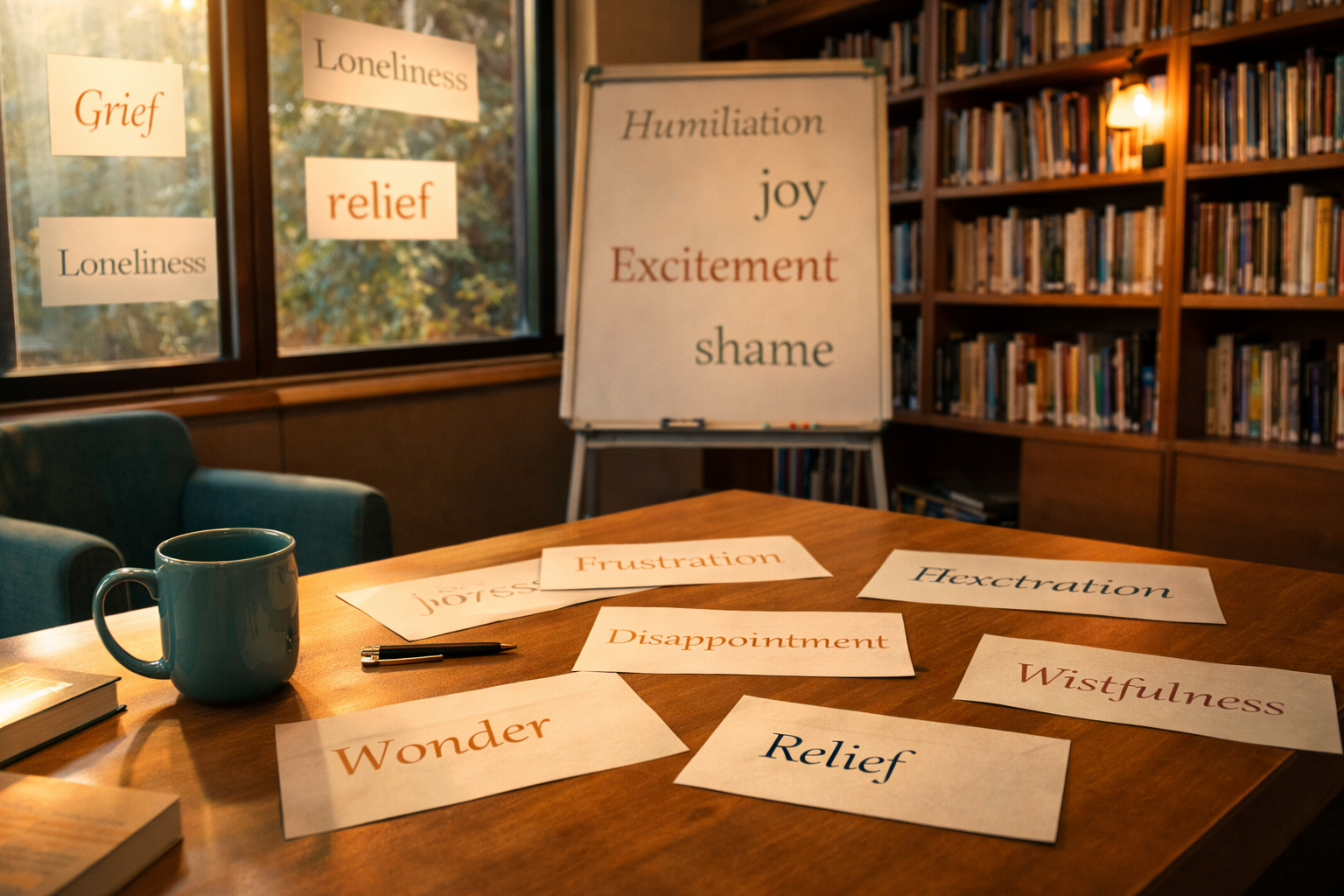
Feelings have many names.
The bigger your vocabulary, the deeper your empathy.
Benne Hart Says:
There's a big difference between sad and devastated. Between angry and humiliated. Between fine and quietly falling apart.

Select all the emotion words that feel familiar to you:
😔 Grief
😞 Disappointment
😶 Loneliness
😰 Shame
😤 Frustration
😳 Embarrassment
😒 Envy
😌 Relief
😊 Gratitude
🤩 Wonder
😟 Wistfulness
😬 Dread
Every word you know for a feeling is a key that unlocks deeper understanding — in yourself AND in others. The more words you have, the more precisely you can understand someone's experience.
Jordan's Story
Let the feeling land — that's Step 3.
Scenario
Two weeks of work. Never shown.
Jordan worked on a science project for two weeks — every evening drawing diagrams, re-reading the science book. On presentation day, the teacher ran out of time. Jordan packed the project away without ever showing it. At home, Jordan sat on the bed and just looked at it.
Benne Hart Says:
Before you think about what to do — just feel for a moment. Stay with Jordan's experience for a second.
How strong is the feeling you have reading Jordan's story?
Barely anythingVery strong
A moderate feeling 💛
What did you feel?
😢
Sad for Jordan
😤
Frustrated on his behalf
🤔
Not much — this hasn't happened to me
🌊
Several things at once
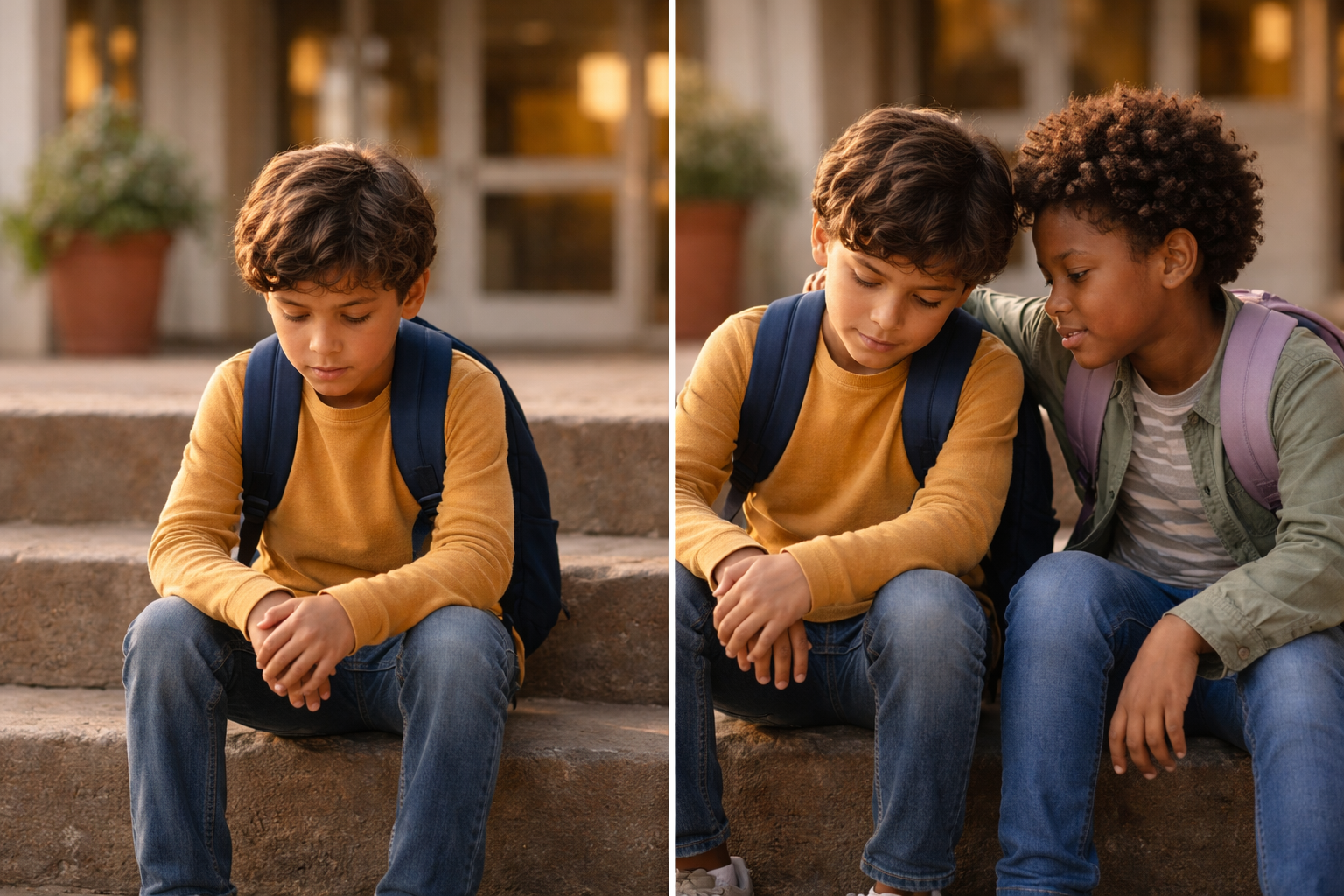
Looking down vs. sitting beside.
Sympathy and empathy are not the same thing.
Benne Hart Says:
Sympathy can be kind. But empathy is deeper. Empathy doesn't try to make it better. It tries to be with someone in his experience. That's what creates real connection.
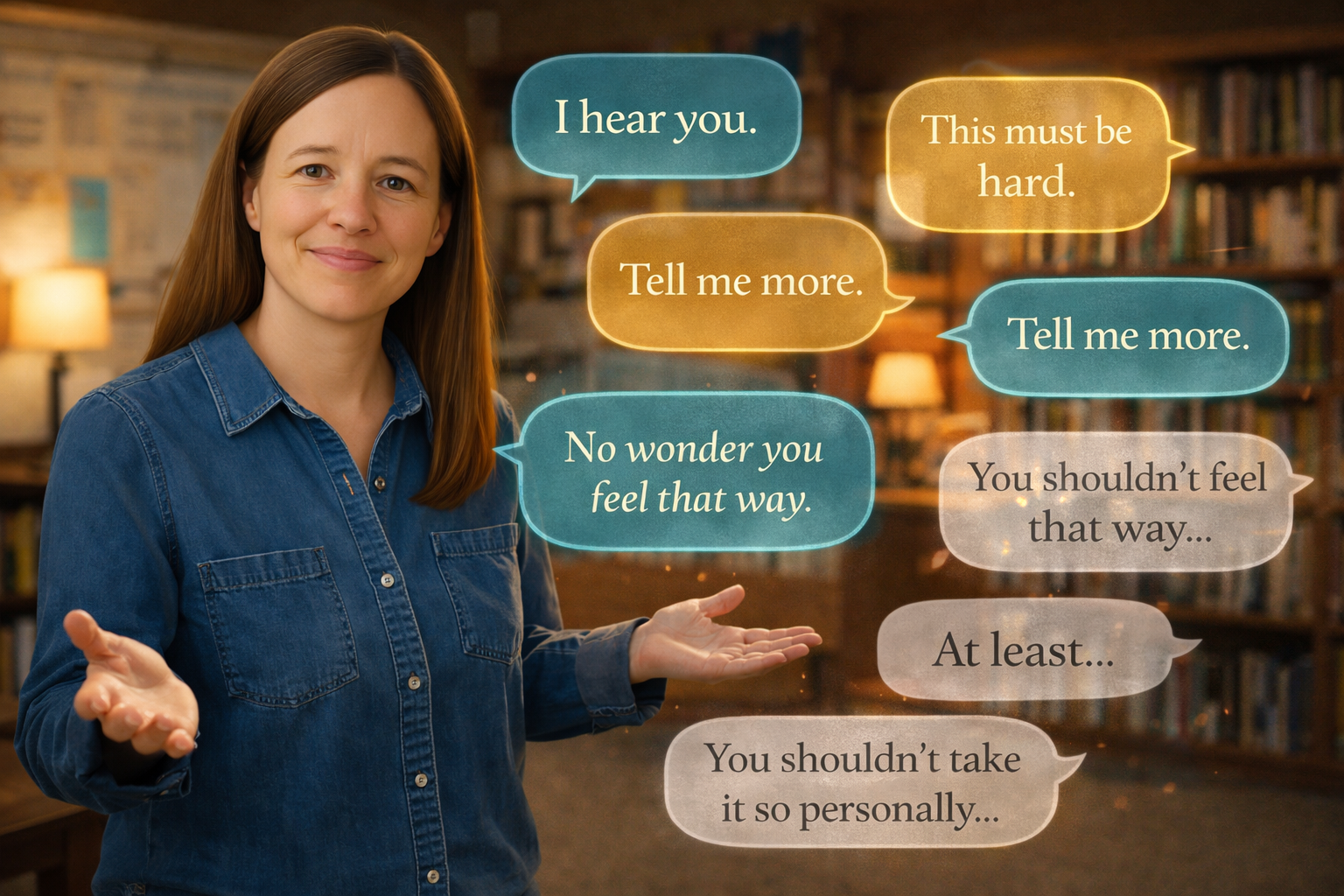
❌ Words That Accidentally Disconnect
"At least it wasn't worse!" • "You'll be fine — you're strong." • "That happened to me too — let me tell you about it." • "Look on the bright side."
✅ Words That Connect
"I can see this is really hard for you." • "I'm here — you don't have to explain." • "That makes sense. Of course you feel that way." • "I don't fully understand, but I want to."
Empathy isn't always automatic. That's okay.
Knowing when it's hard is as important as knowing how to do it.
Benne Hart Says:
Empathy is harder when the other person is someone you're in conflict with, when his experience is very different from yours, when his emotion feels overwhelming, or when you're having your own hard day.

In those moments, empathy doesn't come naturally. That doesn't make you a bad person. It makes you human.
Which makes empathy hardest for you?
😔
When I'm having my own hard day
When it's someone I've had conflict with
🌍
When his experience is nothing like mine
🌊
When his emotion feels too big or intense
Build the bridge.
Imagine Sam — before you think about what to do, just feel.
Scenario: Sam
On the edge. Not invited in. Not told to leave.
Sam has been standing at the edge of the field for ten minutes, watching the game. No one has said "come join." No one has said "go away." Sam is just... on the edge. Holding a ball. Watching.
Benne Hart Says:
Close your eyes if it helps. Imagine: what does it feel like to be Sam right now?
Being Sam right now might feel like... (select all that fit)
👻 Invisible
😟 Uncertain
🙏 Hoping someone notices
😔 Left out
🧊 Too nervous to move
😳 Embarrassed to ask
🪟 Watching life from outside
How much do you think Sam's feeling is affecting his whole day?
Just this momentFollowing him everywhere
You went from "there's a child over there" to "I have a sense of what it's like to be them." You didn't have to have been Sam. You used your imagination and your feeling brain together. That's Step 3: FEEL. ❤️
You've built the Feeling Bridge.
Three steps lit up. Two more to go.
👁️
Notice
🔍
Read
❤️
Feel
🚪
Think
🤲
Act
Benne Hart Says:
You can slow down and see people who are invisible. You can let his feeling connect with yours — building real connection instead of watching from a distance.

Step 4 takes us even deeper. We're going to open the Thinking Door — where you step out of your own perspective entirely and into someone else's.
🚪
Phase 3
The Thinking Door
Step 4: THINK — Stepping into someone else's world.
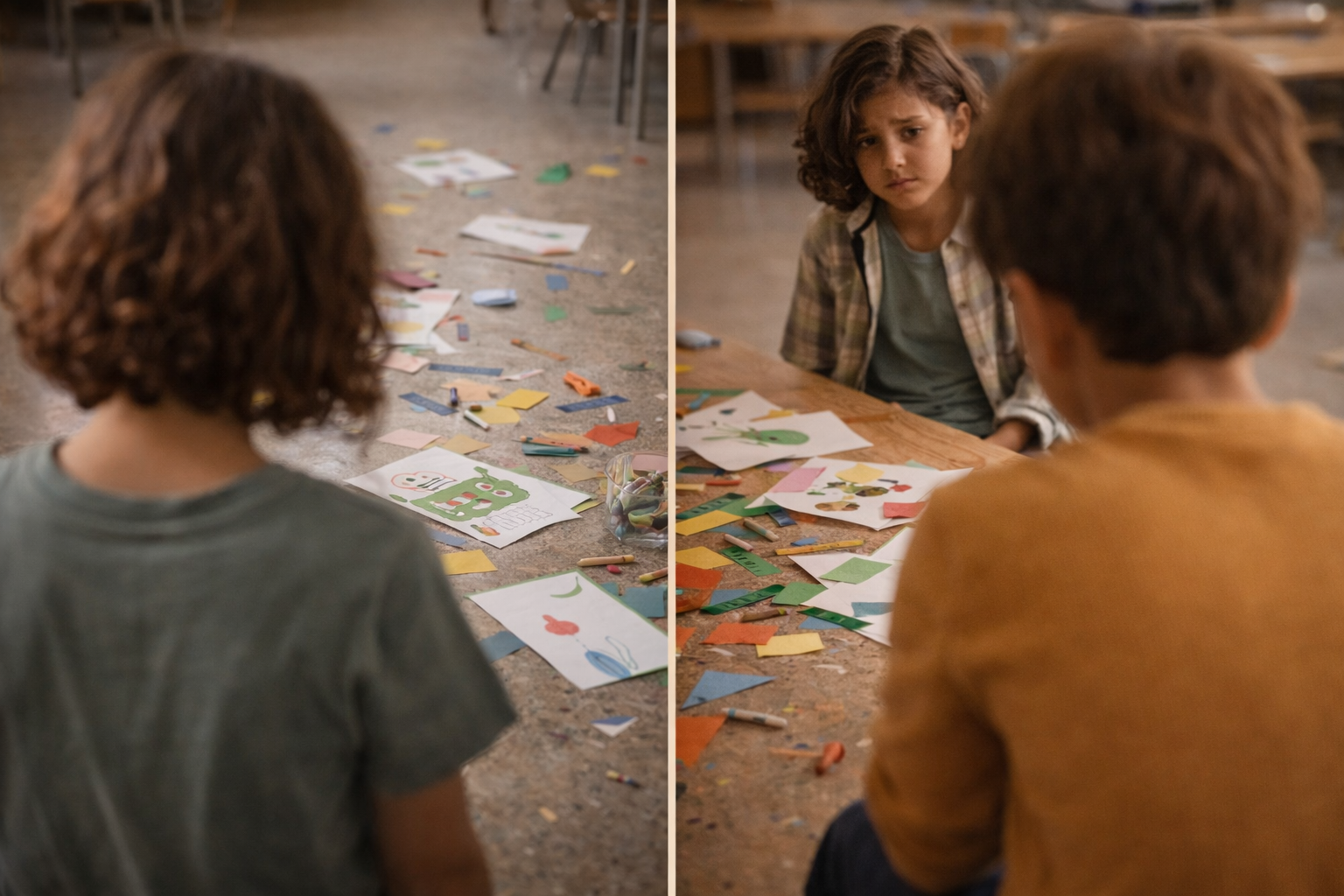
Scenario: The Spilled Project
The same moment — two completely different worlds.
Two children. An art project spills to the floor. One child's project is destroyed. The other accidentally knocked it. Same moment. Two completely different inner experiences.
Benne Hart Says:
Perspective-taking is the ability to mentally step into another person's point of view — to see a situation through his eyes, from inside his experience.

It doesn't mean agreeing with them. It means understanding them.
Everyone has a whole world inside them.
Theory of Mind: understanding that others have different minds from yours.
Benne Hart Says:
Every single person you meet has an entire inner world — his own beliefs, memories, fears, and hopes — that you cannot directly see.

Scientists call this Theory of Mind. Really using it — really remembering that the person in front of you has an inner world just as full and complex as yours — changes everything about how you treat people.
🔬 The Research
Developmental psychologist Martin Hoffman showed that children develop empathy in stages — and the highest stage is understanding someone's entire life situation, not just his immediate feeling. That's what we're practicing.
Has there been a time you assumed you knew what someone was thinking — and were completely wrong?
😮
Yes — and it was surprising when I found out the truth
Yes — and it caused a problem between us
🙂
Not really — I think I read people pretty well
Two questions that open the door.
Use these every time you want to truly understand someone.
🔑 Question 1
"What is this situation like from THEIR side?"

Not from yours. From theirs. What are he seeing, experiencing, and needing right now?
🔑 Question 2
"What do I know — or what could I find out — about his history, fears, or hopes that helps me understand this better?"
Benne Hart Says:
These two questions shift you from observer to participant in someone else's experience. Every perspective-taking exercise from here uses both of them.
Marcus and the scattered books.
Use the Two Questions to understand from the inside.
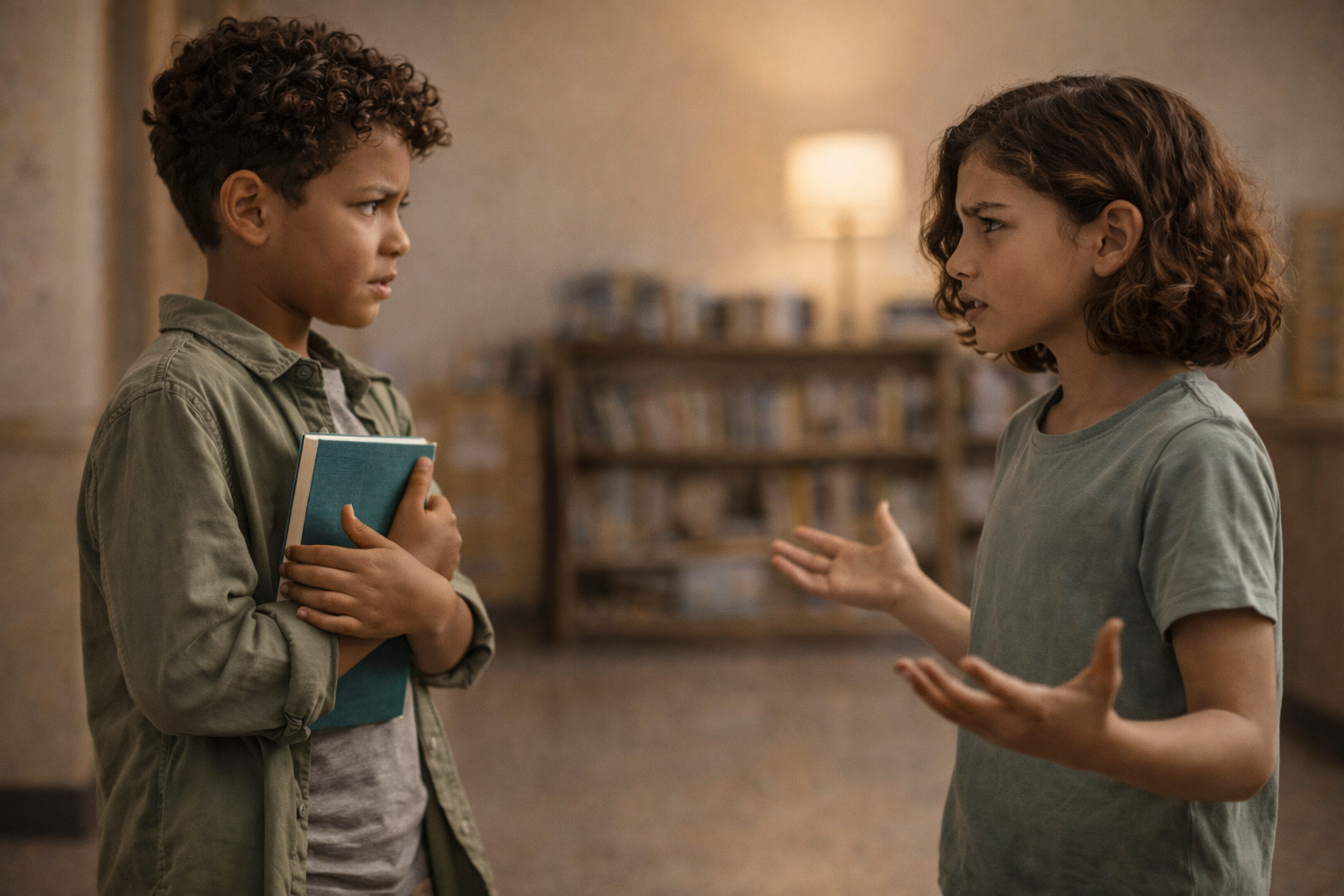
Scenario: The Hallway
Someone knocked his books. Kept walking.
Someone knocked Marcus's books to the floor and kept walking without looking back. Marcus stands still in the hallway, looking at the scattered books. His expression is quiet.
Q1: What might Marcus be feeling? (select all that apply)
😤 Frustrated
😳 Embarrassed
😔 Resigned
👻 Invisible
😕 Confused
Q2: Which context changes your understanding most?
🏠
He's been having a hard time at home recently
🔄
This is the third time this week something like this happened
👥
He's been trying to make friends and keeps being overlooked
Did your sense of Marcus change? That's Question 2 at work. Context deepens understanding. When you know more about someone's world, you see his moments with more compassion. That's Step 4: THINK. 🚪
Empathy doesn't mean agreeing.
Can you understand someone you think is wrong?
Scenario: Lena's Project
Two people. Both feeling justified.
Lena did most of the group project work. On presentation day, her partner accepted equal praise without correcting the teacher. Lena is upset. Her partner felt too embarrassed to interrupt and feels guilty but doesn't know how to say so.
Benne Hart Says:
Understanding WHY someone did something — even something you think was wrong — doesn't mean excusing it. It means you see the whole picture. And when you see the whole picture, you make better choices about how to respond.
What might Lena be feeling? (select all)
😠 Angry
😔 Unappreciated
💔 Betrayed
😳 Embarrassed too
What might the partner be feeling? (select all)
😰 Guilty
😳 Ashamed
😨 Afraid of Lena's reaction
😟 Made a mistake he can't fix
Two different inner worlds. Both real. Both understandable. Perspective-taking gives Lena the full picture — not permission to be hurt, but the context to respond wisely rather than just reactively. 🚪
Everyone is carrying something you can't see.
The invisible backpack changes how you see every interaction.
🎒
The Invisible Backpack
Every person you interact with is carrying a backpack full of experiences, memories, fears, and hopes you cannot see. The child who snapped at you might be carrying a hard morning at home. The friend who seemed distant might be carrying a worry he doesn't know how to talk about.
😰 Worries
🏠 Family stress
💔 Past hurts
🌟 Secret hopes
😳 Fear of rejection
🤫 Hidden feelings
Benne Hart Says:
Instead of "why are he acting like that?" the question becomes: "I wonder what he's carrying right now."

This changes how you respond. Every time.
Think of someone who sometimes confuses or frustrates you. What might be in his invisible backpack?
😰 Worries I don't know about
🏠 Family stress
😔 Loneliness
😳 Fear of not being enough
💔 An old hurt resurfacing
🤫 Something I'll never fully know
That practice of imagining someone's backpack before reacting to his behavior — that is one of the most powerful relationship skills you will ever develop. 🎒
The group project. Three worlds.
Advanced empathy: holding multiple perspectives at once.
Scenario: The Project Table
Priya works. Kieran leans back. Alex watches both.
Three children working together. Priya does most of the writing, looking tense. Kieran leans back, half-attention elsewhere. Alex sits between them, clearly aware of the dynamic, looking between the two.
Priya's world:
😤 Overwhelmed
😠 Frustrated
😟 Afraid the project won't be good enough
🤐 Doesn't want conflict
Kieran's world:
😶 Doesn't realize the imbalance
😟 Struggling with something outside school
😌 Trusts Priya and doesn't know she's upset
😰 Copes with pressure by avoiding
Alex's world:
😬 Uncomfortable in the middle
🤔 Wanting to help but unsure how
😔 Also being overlooked
😟 Worried about the friendship
Three people. Three entirely different experiences of the same moment. When you can hold all three perspectives at once — not deciding who's right, just understanding all three — that is advanced empathy. And you just practiced it. 🚪
You've opened the Thinking Door.
Four steps down. One to go.
👁️
Notice
🔍
Read
❤️
Feel
🚪
Think
🤲
Act
Benne Hart Says:
You've now practiced all four core empathy skills. You can notice the invisible. Read the clues. Feel the connection. Think from the inside.

Phase 4 puts it all together in real-life situations. And Phase 5 is where understanding becomes action.
🌍
Phase 4
Empathy in Real Life
Using all four steps together across four life arenas.
Benne Hart Says:
Empathy isn't just for big dramatic moments. It shows up — and is needed — in ordinary life, every single day. We'll practice one scenario from four real-life arenas.
🏫
Classroom
With classmates you know well and those you barely notice
👫
Friendship
With the people you're close to, especially when complicated
🏠
Family
With the people hardest to see clearly because he's so familiar
🌳
Community
With people whose lives look different from yours
Arena 1: The Wrong Answer
Classroom empathy — the moment after a mistake.
Scenario: Maya
She answered confidently. She was wrong. Everyone heard.
Maya answered a question confidently — and was wrong. The teacher corrected her gently, but the whole class heard. Maya is back at her desk, staring at it, face controlled, not letting anyone see how she feels.
Benne Hart Says:
Run all four steps: NOTICE her stillness, READ the controlled expression, FEEL what it's like to be corrected in front of everyone, THINK about what she might need right now.
If you were sitting next to Maya, which feels most empathic?
🗣️
Lean over quietly: "that happens to everyone"
🙂
Say nothing — just catch her eye with a small smile
⏱️
Wait until after class to check in privately
🌿
Give her the space she seems to need right now
There's no single right answer — and that's the point. Real empathy means reading the person in front of you and responding to them, not to a script. All of these can be right for the right Maya. 🌟
Arena 2: The Cancelled Plan
Friendship empathy — even when you're the one hurting.
Scenario: Daniel
Plans you'd been looking forward to all week — gone.
Your close friend Daniel cancelled plans you'd been looking forward to all week. No real explanation — just "sorry, can't make it." You're disappointed. You've been looking forward to this for days.
Benne Hart Says:
Wait — before we think about Daniel, let's use the Empathy Steps on yourself first. What story are you telling yourself about why he cancelled?
What are the POSSIBLE reasons Daniel might have cancelled?
🏠 Something happened at home
🤒 He wasn't feeling well
😰 He was stressed about something
😔 He just didn't feel like it today — and that's allowed
🤫 Something I don't know about
Before we feel hurt, can we hold the possibility that Daniel's world may be happening too? Empathy in friendship means extending the benefit of the doubt — not because the disappointment isn't real, but because the story we tell about "why" affects everything about how we respond. 💛
Arena 3: The Quiet Parent
Family empathy — the quietest kind.
Scenario: The Kitchen
They said "I'm fine." But something is different.
Your parent/caregiver has been quieter than usual tonight. He made dinner, helped with homework, but his face looks heavy. When you ask "are you okay?" he say "I'm fine" — too quickly.
Benne Hart Says:
Empathy with family members is often the hardest — because we know him so well, we think we already know what he feel. We stop noticing. But the people closest to us are sometimes the ones we see least clearly.
What might "I'm fine" actually mean here?
😊
They're genuinely fine — sometimes people are just quiet
🤐
They don't want to worry me
💭
They can't fully explain it yet, even to themselves
They need a moment before he's ready to share
Adults carry things too — often very heavy things — and he carry him quietly because he love you. The most empathic response to "I'm fine" when you can see it isn't fine? Sometimes it's simply sitting near them. Present. Not pressing. Not disappearing. "I see you. I'm here." 💛
Arena 4: The New Kid
Community empathy — the person who just arrived.
Scenario: New Student
His third day. Lunch alone.
A new student joins your class. It's his third day. At lunch, he sits alone because he doesn't yet have anyone to sit with. He's not dramatic about it — just watching, reading the social map of a new place.
What is it like to be the new kid, even during one lunch period? (select all)
🧮 Calculating every move
😟 Not wanting to seem desperate for connection
🌟 Hoping today might be the day
😔 The longing to belong
😓 Exhausted from reading a new social map
Benne Hart Says:
Have you ever been the new kid — even in a small way? Joining a new group, being the only one who didn't already know everyone?

Whatever you needed from the people already there? That is what the new kid in your class needs from you. The feeling of "where do I fit?" is universal.
Empathy has a language.
The words you choose matter enormously.
Benne Hart Says:
Empathy isn't just a feeling you have inside — it's something you express. There are words that make people feel seen, and words that — even with good intentions — make people feel more alone. Let's sort them.
Which of these CONNECT? (tap to select)
✅ "I can see this is really hard for you."
❌ "At least it wasn't worse!"
✅ "I hear you — that sounds exhausting."
❌ "You'll be fine, you're strong."
✅ "I don't fully understand, but I really want to."
❌ "That happened to me too — let me tell you."
✅ "You don't have to explain — I'm just here."
❌ "Look on the bright side."
✅ "That makes sense — of course you feel that way."
The disconnecting responses often come from people who care deeply — he's trying to help, to encourage, to make the pain smaller. But he accidentally say: "your feeling is too much, let me move you past it." The connecting responses say: "I'm landing beside you." 💛
Important: What empathy is NOT.
These misunderstandings make empathy feel impossible.
Benne Hart Says:
Before Phase 5, I want to make something very clear — because these misunderstandings can make empathy feel exhausting or impossible.
❌ Empathy does NOT mean:
Agreeing with everything someone does
Sacrificing your own feelings
Staying in situations that harm you
Absorbing so much you have nothing left
Feeling guilty when you can't empathize perfectly
✅ Empathy DOES mean:
Genuinely trying to understand someone's inner world
Responding to what he actually need
Holding space without fixing or minimizing
Seeing the full humanity in people
Choosing connection over assumption
Is there anything in the "does NOT mean" list you've been confusing with empathy?
🤝
Yes — I thought I had to agree to be empathic
🪫
Yes — I've taken on so much of others' feelings I felt depleted
🔗
Yes — I've stayed in difficult situations because I "understood" why
Not really — most of this is clear to me
You've practiced all four steps in real life.
Now for the final step — where understanding becomes action.
👁️
Notice
🔍
Read
❤️
Feel
🚪
Think
🤲
ACT
Benne Hart Says:
This is not small. You've practiced noticing the invisible, reading the inner world, feeling the connection, and thinking from inside four different life situations.

Now: what do we DO with that understanding? That's the Compassion Step — and it changes everything.
🤲
Phase 5
The Compassion Step
Step 5: ACT — From understanding to action.
Benne Hart Says:
Compassion is empathy with a direction. It takes the feeling and understanding and transforms him into action — the desire to do or say something that helps.

Researchers have found that compassion also protects against empathy fatigue: it shifts you from "this is painful" to "I can do something." That shift is everything.
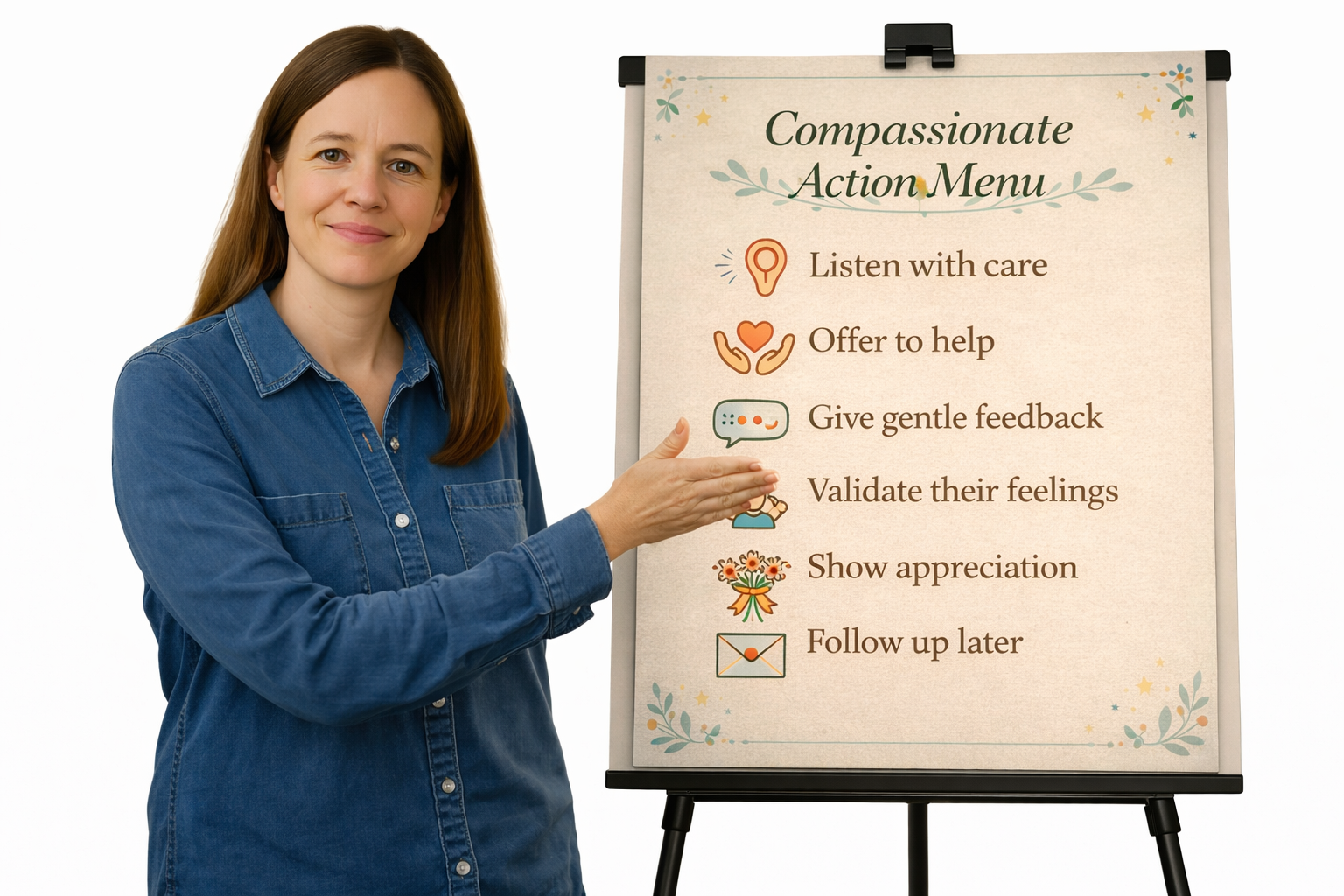
Compassionate action doesn't have to be big.
It's almost always small, ordinary, and chosen.
Benne Hart Says:
When we understand what someone is going through, it can feel like we need to say the perfect thing. We don't. Compassionate action is almost always small. It's the decision to show up rather than look away.
🪑
Presence
Simply being near someone, without fixing or talking
🗣️
Acknowledgment
"I noticed you seem to be having a hard time"
🚪
Open Door
"I'm here if you ever want to talk"
💌
Small Gesture
A note, a smile, saving a seat, sharing something small
Asking First
"Is there anything you need?" — not assuming
🔄
Following Up
Checking in later — not forgetting about them
Which feels most natural for you to offer?
🪑
Presence — just being there
🗣️
Words — saying something meaningful
💌
Small gestures — notes, smiles, small acts
🔄
Following up — remembering and checking in later
Knowing your natural style is valuable — you can lead with your strength. And you can grow toward the ones that feel harder. Let's practice. 🌱
What would you actually do?
Theo has been alone at the playground for three days in a row.
Scenario: Theo
Not dramatic. Just alone. Three days running.
Theo has been standing alone at the edge of the playground for the whole break. You've noticed him three days in a row. You don't know him well. Today you have a moment to do something.
Benne Hart Says:
You've run all four Empathy Steps. Now: Step 5. ACT. Which compassionate action would you choose?
🚶
Walk over and introduce yourself
🙌
Invite Theo to join what you're doing
🙂
Start with eye contact and a smile
💬
Say something simple: "Hey, what are you up to?"
👥
Tell a friend about Theo and suggest you all include him
Every single one of those is compassionate action. Different levels of directness — but all coming from the same place: you saw Theo, you felt something, you understood something, and you chose to do something. That choice is the whole point. 🤲
The moment before the moment.
Five seconds. What do you do?
Scenario: Lily
A significant mistake. Everyone just discovered it. No one has spoken yet.
In your group project, Lily has made a significant error. The group has just discovered it. The next five seconds will determine whether Lily feels supported or humiliated. You haven't spoken yet.
Benne Hart Says:
What do you do in those five seconds?
🤝
"That's okay — we can fix this together"
😌
Look at Lily with a calm expression that says you're not alarmed
💡
"This happens — let's just figure out the solution"
🗣️
Speak to the group: "let's not make this a big deal"
Notice something: several of these happen in five seconds or less. No grand gesture. No long speech. Compassionate action is often about what you choose NOT to do — the eye-roll you hold back, the judgment you keep to yourself. The compassion that protects someone's dignity in a difficult moment may be the most powerful empathy you ever exercise. 🌟
Compassion when it costs something.
The hardest compassion is the most important.
Benne Hart Says:
The compassionate actions we've practiced have been relatively comfortable. But some situations ask more:

What if standing with someone means standing against the group? What if the compassionate thing is telling a truth that's uncomfortable? What if showing compassion makes you look "too soft"?

The compassion that costs something is the compassion that matters most.
Has there been a time when you knew the compassionate thing to do — but it would have cost something?
I did it — and it was worth it
💪
I did it — and it was harder than I expected
😔
I chose the easier path — and I still think about it
🌱
I've never been in that situation yet
Your Empathy Commitment.
Not a performance. A real, personal direction.
Benne Hart Says:
You've traveled through all five Empathy Steps. Now make a personal commitment — one from each section. This will appear on your certificate.

This week, I will NOTICE:
👁️
Someone who seems to be on the outside of something
🤫
Someone who answers "fine" but might not be
💛
Someone I've been taking for granted
When someone struggles, I will REMEMBER:
🎒
They have an invisible backpack I can't see
🌉
Empathy doesn't require me to have lived the same thing
🤝
I can choose connection over comfort
My Compassionate Action commitment:
🪑
Offer presence to someone who needs to not be alone
💬
Say something rather than nothing when I see someone hurting
🔄
Follow up with someone I know is having a hard time
All five steps. Lit up.
NOTICE · READ · FEEL · THINK · ACT
👁️
Notice
🔍
Read
❤️
Feel
🚪
Think
🤲
Act
Benne Hart Says:
You have practiced all five Empathy Steps.

You have done something very few people ever do deliberately: you have trained your mind and your heart to see, understand, and respond to what other people are carrying.

The world needs what you've practiced today. Let's go celebrate that.
What has changed?
Before the certificate — your own honest reflection.
Benne Hart Says:
Three reflection questions. No right answers — just yours.
What is one thing you now see in people that you didn't fully notice before?
🧍
Body language I was walking past
🎒
The invisible backpack everyone carries
🖼️
How much context matters in reading a moment
Which Empathy Step felt most new or challenging?
👁️
NOTICE — slowing down to really see
❤️
FEEL — letting someone's emotion touch mine
🚪
THINK — genuinely stepping into another's perspective
🤲
ACT — choosing compassion especially when it costs
Those answers belong to you. Hold him as intentions, not obligations. Growth in empathy is a direction, not a destination. 💛
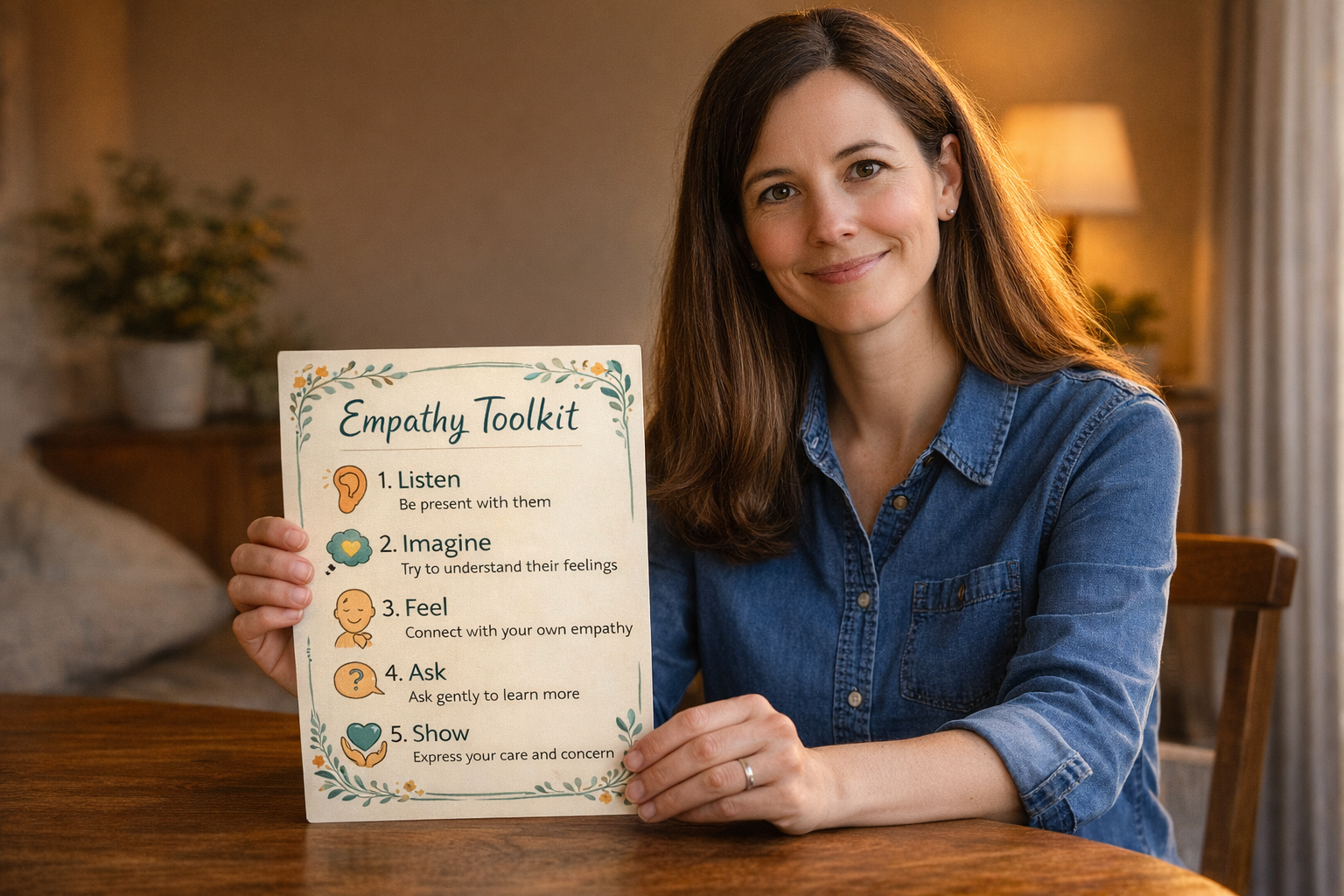
Your Empathy Toolkit.
Everything you need — always with you.
👁️
Step 1
NOTICE
🔍
Step 2
READ
❤️
Step 3
FEEL
🚪
Step 4
THINK
🤲
Step 5
ACT
🔑 Key Questions to Carry
• "What is this like from his side?"
• "What might be in his invisible backpack?"
• "What do he need — not what do I want to give them?"
• "What compassionate action is available to me right now?"
💬 Empathy Language to Use
• "I can see this is hard for you."
• "I'm here — you don't have to explain."
• "That makes sense — of course you feel that way."
• "I don't fully understand, but I want to."
• "Is there anything you need right now?"
A note for the grown-ups.
How to extend this learning at home and school.
📋 What Your Child Practiced
Identifying emotions through facial expression, body language, and context. Building both affective empathy (feeling with others) and cognitive empathy (perspective-taking). Recognizing the difference between sympathy and empathy. Applying the Five Empathy Steps across four real-life contexts. Understanding the empathy–compassion distinction and choosing compassionate action.
🏠 Extending Learning at Home
Use empathy language in everyday moments — "I wonder what he might have been feeling" opens more than "why did he do that?"

When your child is in conflict, invite perspective-taking before problem-solving: "What do you think was going on for them?"

Debrief books and shows with empathy questions: "What was that character carrying? What would you have needed if you were them?"
🌟 The Most Powerful Thing You Can Do
Model empathy yourself — including toward people who are difficult, different, or distant from your own experience. The single most powerful driver of empathy development in children is watching the significant adults in his lives exercise it genuinely.


🌟
You did it!
Brave Feelings Lab
Empathy Builder Lab
This certifies that
Young Empathy Builder
has completed the Empathy Builder Lab journey
and is now a certified Empathy Builder 💛
My Empathy Commitment
Loading your commitment...
👁️ NOTICE
🔍 READ
❤️ FEEL
🚪 THINK
🤲 ACT
Go be that person.
What you practiced today lives in how you show up for others.
Benne Hart Says:
I am genuinely proud of you.

Empathy Builder Lab isn't something that ends when you close this screen. What you practiced lives in how you walk into a room, how you read a face, how you respond to someone who's having a hard time.

Go notice the people who need to be seen. Go sit beside instead of looking down. Go be the person who makes others feel like he are not alone in the world.

That is what you're capable of. I've seen it today. 🌟